
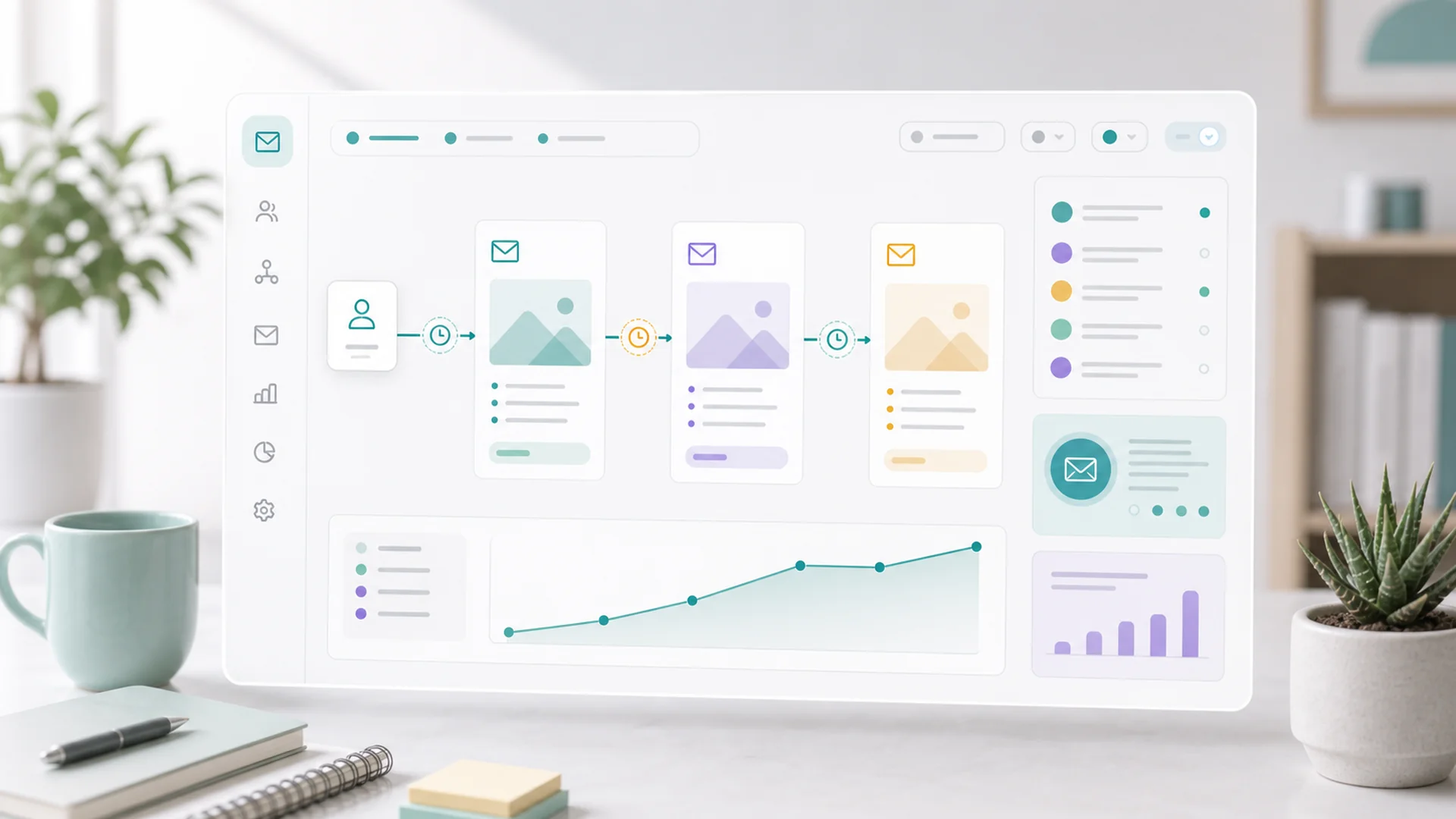
A welcome sequence is 3–4 automated emails sent in the first week after someone signs up — when their interest peaks. Each email has exactly one job: deliver what was promised, build trust with a story, then make one clear offer. Below are three complete templates — for a service business, a course creator, and an online store — with timing and subject lines.
The first 48 hours after a signup are the warmest your relationship will ever be — and the moment most businesses go silent. A welcome journey fixes that permanently: you write the emails once, connect them to your signup form, and every future subscriber gets the same well-timed introduction. The hard part isn't the automation — it's knowing what to say. So let's steal proven structures.
The rules all three templates share
- One job per email. Deliver, then connect, then offer. An email doing two jobs does both badly.
- Email 1 goes out in minutes, not hours. It confirms the signup worked and sets expectations while attention is still on you.
- Write like one person emailing another. Short paragraphs, no banner graphics required, a real reply-to address.
- The sequence ends. Three or four emails, then the subscriber graduates to your regular newsletter — endless drips erode trust.
Template 1 — Service business (the quote-getter)
For plumbers, designers, consultants, cleaners — anyone whose signup magnet is a pricing guide, checklist, or assessment offer. Goal: a booked call or quote request.
Deliver the guide as a link, in the first line. Then two sentences: what you'll send next ("two short emails this week"), and the one question customers ask most — answered in two lines. You've just proven the emails are worth opening.
One short story from a real job: the problem you found, what it would have cost if ignored, what it cost to fix early. No pitch — the story does the selling. End with "reply if this sounds familiar".
The offer, plainly: a free assessment, an intro discount, or simply the booking link. One button, one deadline if you have a real one, and the reassurance line: what happens after they book.
Template 2 — Course creator (the trust-builder)
For anyone selling knowledge — courses, workshops, coaching. The signup magnet is usually a free lesson or mini-guide. Goal: first enrollment. This one earns a fourth email, because education sales need more trust.
The free lesson, plus a specific promise: "by Friday you'll know X." Specificity is what separates a course from content.
Your best free insight — the one that makes people forward the email. Teaching generously here is the sales pitch.
A student story with a before and after. If you don't have one yet, tell your own before-and-after honestly — it works nearly as well.
The enrollment offer: what's included, who it's for, who it's NOT for (the honesty converts), price, and one button. A founding-member discount or bonus gives the fence-sitters a reason to move now.
Template 3 — Online store (the first-order closer)
For product businesses where the magnet is usually "10% off your first order." Goal: the first purchase — because a customer who's bought once is several times easier to sell to again.
The code, big and copyable, with its expiry date stated. One row of your three bestsellers underneath — not the whole catalog.
The story only you can tell: materials, process, the reason the business exists. Product photos in context, not on white. This is the email that makes you a brand instead of a discount.
The honest nudge: code, expiry, bestsellers, button. Add your two most-loved customer reviews — borrowed confidence for a first order.
Write it once. It welcomes every customer you'll ever get.
An hour of writing today runs for years — that's the best return in marketing.
Wiring it up (15 minutes)
- Connect your signup form to the journey — check the form captures email and that field data maps to the customer record first, so later emails can use what you know.
- Add the emails with waits between them (minute 1 → day 2 → day 5), matching your template above. If your flow is simpler, a straight email sequence does the same job without branching.
- Preview every email, send yourself a test, and check the journey's exit rule — someone who books or buys mid-sequence shouldn't keep getting "book now" emails.
- Sign up through your own form with a personal address. Receiving your own welcome sequence is the only test that counts.
Two pieces of hygiene: every email needs a working unsubscribe (and honor it instantly), and after the sequence ends, graduates should flow into your regular newsletter audience — welcomed, not abandoned.
Key takeaways
- Deliver → connect → offer: one job per email, three or four emails total.
- Email 1 in minutes: the promised thing, in the first line, plus what's coming next.
- Stories sell, pitches don't: the middle email is a customer story or your best free teaching.
- One offer, one button: the closing email makes a single clear ask with a real deadline if you have one.
- Exit rules matter: buyers leave the sequence; everyone else graduates to the newsletter.
Frequently asked questions
How long should each email be?
Under 150 words for emails 1 and 3; the story email can run to 250 if the story earns it. If an email needs a scroll bar, it's doing two jobs.
Won't three emails in a week annoy people?
Not in the first week — they just asked to hear from you, and this is the one window where frequent email reads as attentive rather than pushy. The annoyance risk is the opposite pattern: silence for a month, then a sales blast from a sender they've forgotten.
Should I use AI to write the emails?
Use it for the first draft against these templates, then edit in your own stories and numbers — the story email especially has to be true. Draft with AI, humanize by hand, and you'll have the sequence written within the hour.
What should I measure?
One number per email: email 1's open rate (deliverability check), the story email's reply/click rate (resonance check), and the offer email's conversion (the actual goal). Tweak the worst performer monthly; leave the rest alone.
Can someone be in two sequences at once?
Avoid it during the welcome week — pause other enrollments until the welcome ends, or make the welcome the only automated sender for new contacts. Two automated voices in one inbox reads as spam even when each is fine alone. You can always pause a sequence for a specific customer when a real conversation takes over.
Pick the template closest to your business, change the details to true ones, and wire it to your form this week. The help center covers every connection step — and your next signup gets a better first week than any subscriber before them.