
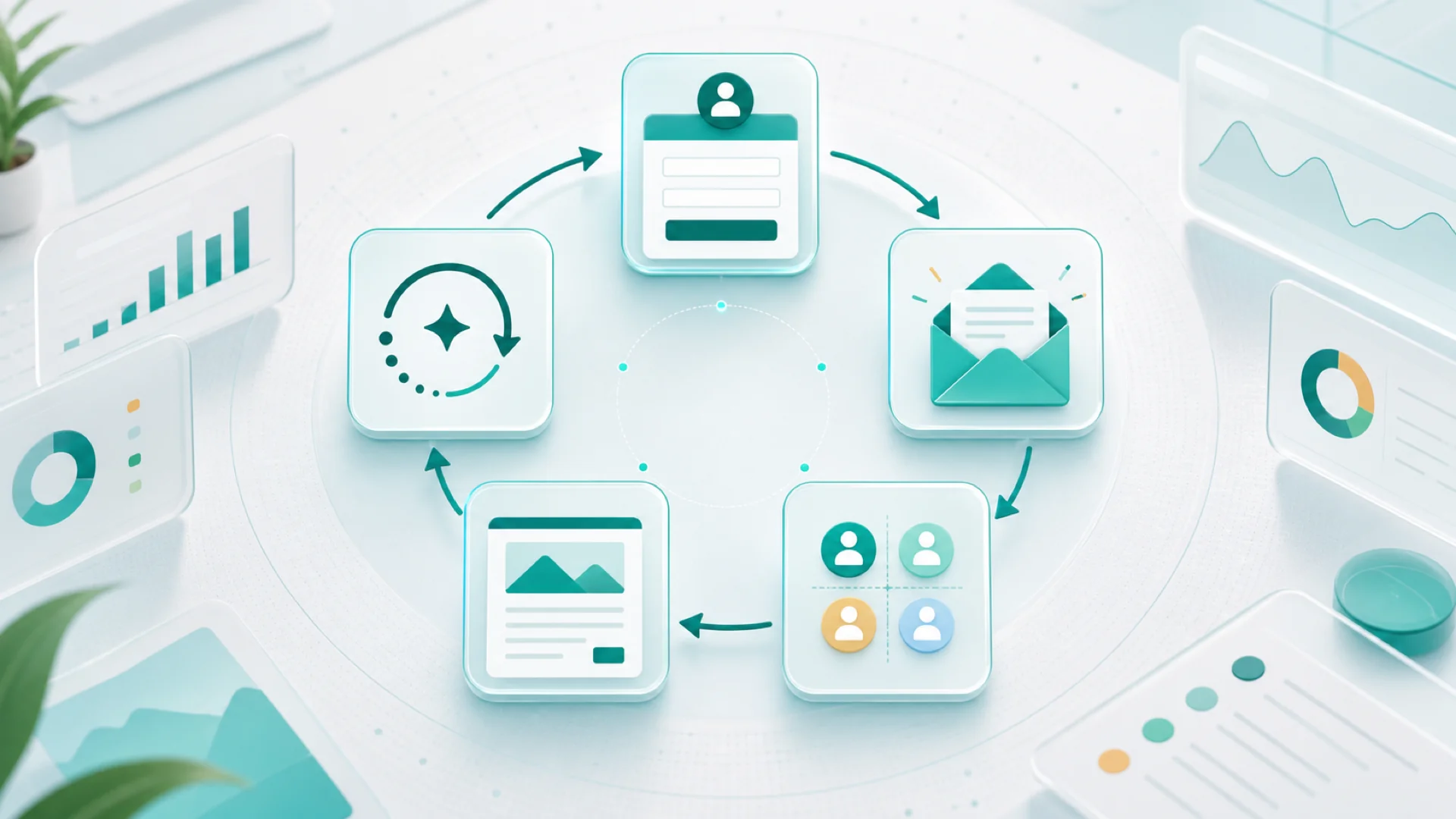
Email marketing for a small business comes down to five moves: capture addresses on your website, welcome new subscribers automatically, segment people by what they actually do, keep a steady newsletter habit, and let automation handle the moments you would otherwise forget. This guide walks through each one.
Social platforms decide who sees your posts. Search rankings shift under your feet. Your email list is the one audience you actually own — and for most small businesses it quietly outperforms everything else. Here is the whole playbook, in the order you should build it.
Why email still wins for small teams
Email is the only marketing channel where you control the audience, the timing, and the message — no algorithm in between. It is also the cheapest: once someone joins your list, reaching them again costs essentially nothing. That changes how you think about every other channel. Social posts, webinars, and blog articles stop being the goal and become the top of a funnel whose job is simple: turn attention into an email address.
A 1,000-person list you own beats 10,000 followers you rent.
Reach on rented platforms is a percentage someone else sets. Reach on email is your open rate — and you can improve it.
Build a list people want to join
Nobody fills in a form labeled "Subscribe to our newsletter" out of enthusiasm. People trade their email for something specific: a price guide, a checklist, a discount on the first booking, a free lesson from your course. Pick one offer your ideal customer would genuinely want, and build a lead capture form around it.
Placement matters as much as the offer. Three spots earn most of the signups:
- The end of every blog post and guide — readers who finish are your warmest visitors.
- Your highest-traffic page, usually the homepage or a popular service page.
- The confirmation moments — after a booking, a purchase, or a download, when trust is highest.
Keep the form short. Name and email are enough to start; everything else you can learn later from behavior. Add tracking fields behind the scenes so you know which page and which campaign produced each signup — future you will thank present you when it is time to double down on what works.
Welcome new subscribers automatically
The first 48 hours after someone joins your list are when they are most interested in you — and the moment most small businesses go silent. A welcome journey fixes that once, forever. Three emails are plenty:
| When | Job | |
|---|---|---|
| Minute 1 | Deliver the thing | Send whatever you promised, fast. Set expectations: what you send, how often. |
| Day 2 | Tell your story | Who you are, who you help, one customer result. No pitch yet. |
| Day 5 | Make one offer | One clear next step: book a call, claim the intro offer, start the course. |
Write these once, connect your signup form to the journey, and every future subscriber gets the same well-timed introduction while you sleep.
Segment before you send
The fastest way to ruin a list is to send everything to everyone. Unsubscribes climb, opens sink, and the people who would have bought stop reading. The fix is segmentation — and it is simpler than the word sounds. Start with two or three audiences based on what people do, not who you guess they are:
- Customers vs. not-yet customers. The single most useful split. Prospects get education and offers; customers get value, updates, and reasons to return.
- Engaged vs. quiet. People who opened or clicked recently can hear from you more often. The quiet group gets your best content only — or a win-back sequence.
- By interest. If you offer multiple services, segment by the page or offer that brought each person in.
Behavior-based segments update themselves. Someone books a first appointment and they move from prospect to customer automatically — no spreadsheet, no manual list hygiene.
Keep the newsletter habit
Sequences and automations do the precision work; the newsletter keeps the relationship warm in between. The businesses that win with email are rarely the cleverest writers — they are the most consistent ones.
A sustainable format for a busy owner: one useful idea, one quick story or result from your work, one link to something you published or are offering. Fifteen minutes to write, every other week, forever. Twice a month beats a brilliant monthly issue that quietly dies in March — and a simple repeated structure means subscribers know what they are getting and you never face a blank page.
Automate the moments that matter
Beyond the welcome journey, a handful of automated sequences quietly compound. Build them in this order:
- Follow-up after a quote or inquiry — most sales are lost to silence, not to competitors. Two polite nudges recover a surprising share.
- Post-purchase or post-visit — a thank-you, care instructions or next steps, then a review ask a week later.
- Win-back — when a customer goes quiet for 60 or 90 days, three emails: a check-in, your best content, a come-back offer.
Each of these is written once and then runs on every matching customer. This is where email stops being a marketing task and starts being infrastructure.
Deliverability: the unglamorous part that decides everything
None of the above matters if your email lands in spam. The good news: deliverability is mostly hygiene, not wizardry.
- Send from your own domain with authentication set up — not from a free inbox address.
- Never buy lists or add people who did not opt in. One spam complaint outweighs a hundred opens.
- Honor unsubscribes instantly and make the link easy to find — fighting it only damages your sender reputation.
- Watch bounces. When an address hard-bounces, stop sending to it; if a campaign shows unusual bounces or skips, investigate before the next send.
Measure three numbers, ignore the rest
Dashboards are full of metrics that do not change decisions. For a small business, three are enough: list growth (are signups outpacing unsubscribes month over month?), click rate (opens are flattering, clicks are intent), and revenue per send for anything with an offer in it. Review them monthly, and let them pick your next experiment — a better signup offer, a different send day, a sharper subject line.
Key takeaways
- Own the channel: every other channel's job is to grow your email list.
- Trade value for emails: a specific offer beats "subscribe to our newsletter" every time.
- Automate the first 48 hours: a three-email welcome journey, written once.
- Segment by behavior: customers, engagement, and interest — let the segments update themselves.
- Consistency over brilliance: a simple newsletter every two weeks, plus follow-up, post-purchase, and win-back sequences running in the background.
Frequently asked questions
How often should a small business send email?
Every two weeks is the sweet spot for most small businesses: frequent enough that subscribers remember you, light enough to sustain. Automated sequences run on top of that cadence without adding to your workload.
How big does my list need to be before email is worth it?
It is worth it from subscriber one, because the system you build — welcome journey, segments, sequences — works identically at 50 and at 50,000. Small lists often convert better: they are full of people who actually know you.
Should I clean my list, and when?
Yes — remove hard bounces immediately and consider a win-back sequence for anyone quiet for 90 days. If they ignore three win-back emails, let them go. A smaller, engaged list delivers better than a big, cold one.
What should my first lead magnet be?
The answer to the question customers ask you most, packaged: a pricing guide, a preparation checklist, a short email course, or a first-time discount. If you already answer it weekly by phone or DM, it will convert as a download.
Do I need different emails for prospects and customers?
Eventually, yes — it is the highest-impact segmentation you can do. Prospects need proof and a reason to start; customers need value and a reason to return. Even one different email per month between the two groups noticeably lifts results.
Email is the rare marketing channel that compounds: every form, journey, and segment you set up keeps working next month without you. Build the five pieces in order, and revisit the numbers monthly. If you want the step-by-step product walkthroughs, the help center covers every screen mentioned here.